

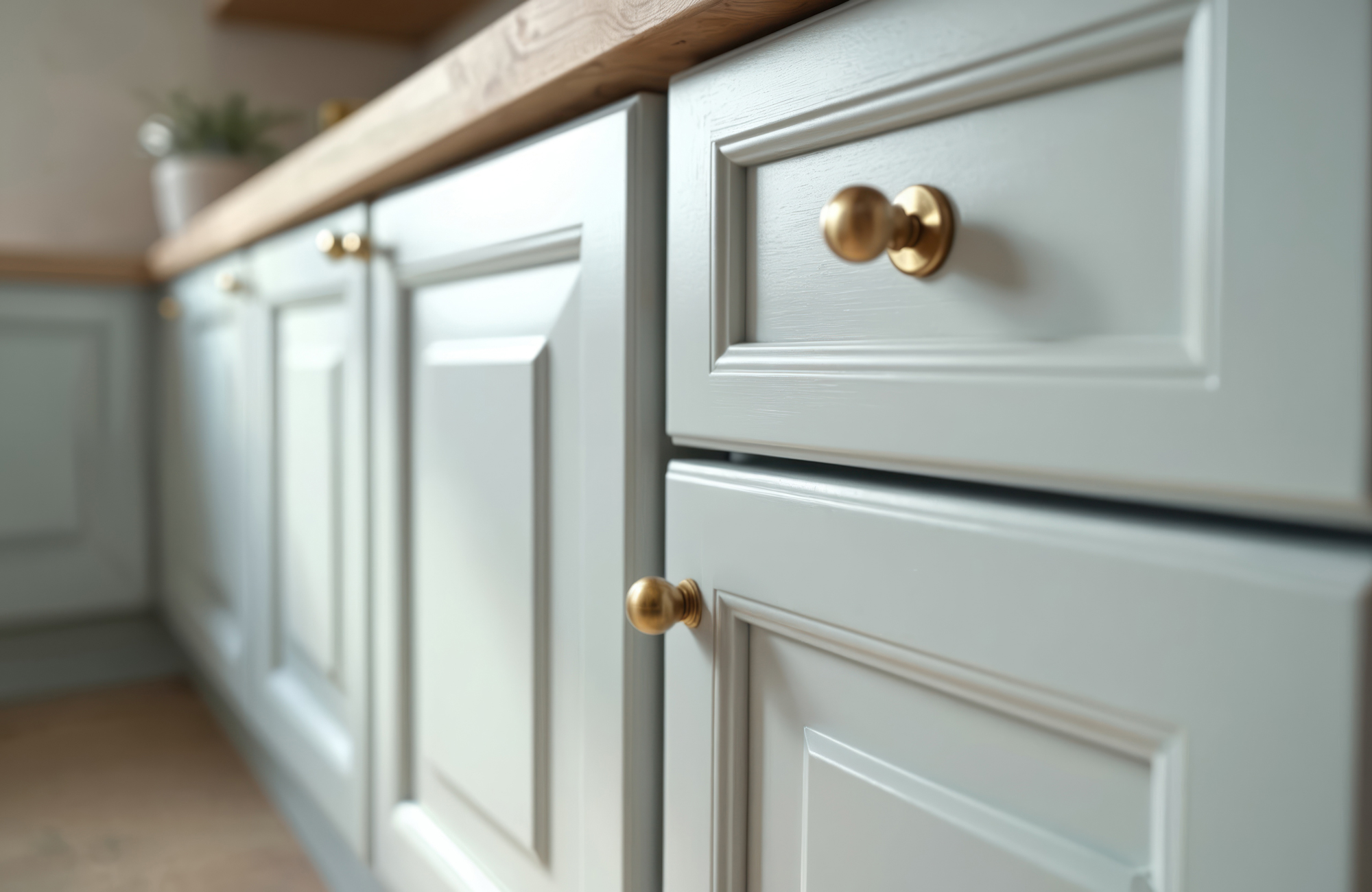
A kitchen does not have to rely on one cabinet color or finish to feel cohesive. Combining natural wood cabinets with painted cabinets can add depth, warmth, and contrast while keeping the design polished. It is also a flexible approach for builders who want kitchens to stand out without creating overly complicated finish packages. The key is balance. Wood and painted cabinets should look intentional, with each finish playing a clear role in the overall design.
Why mix wood and painted kitchen cabinets?
Painted cabinets provide clean, consistent color, while stained wood introduces natural grain, warmth, and variation. Together, they create contrast without requiring bold colors or elaborate design details.
Mixed finishes can also define different areas of a kitchen. Wood cabinetry might highlight an island, beverage station, or other focal point, while painted cabinets provide a consistent backdrop around the perimeter.
For builders and developers, this approach offers flexibility. Similar kitchen layouts can take on different looks by changing cabinet colors, wood tones, countertops, and hardware.
Choose one dominant cabinet finish
One of the easiest ways to keep a mixed-cabinet kitchen balanced is to establish a dominant finish.
Instead of dividing wood and painted cabinets equally throughout the room, use one for most of the cabinetry and the other as an accent. Painted perimeter cabinets with a stained wood island are a classic example.
The reverse works, too. Wood perimeter cabinets paired with a painted island can create a strong focal point and break up the visual weight of natural wood.
Keeping one finish dominant gives the kitchen a clear hierarchy and makes the design easier to repeat across multiple projects.
Use the kitchen island for contrast
The kitchen island is often the easiest place to introduce a second cabinet finish because it is already visually separate from perimeter cabinetry.
White, cream, taupe, or gray perimeter cabinets can pair with a medium or dark wood island. The wood brings warmth and anchors a bright kitchen. In a kitchen dominated by wood cabinetry, a painted island can provide contrast and create a lighter, more contemporary feel.
This approach works especially well in large kitchens and open floor plans where the island is visible from adjoining living spaces.
Coordinate wood tones with surrounding materials
Wood cabinets should complement the other materials in the kitchen, including flooring, countertops, backsplash tile, and nearby architectural details.
The wood tones do not need to match exactly. Instead, focus on coordinating undertones. Warm wood cabinetry generally pairs naturally with other warm finishes, while neutral or cooler woods can work well with white, gray, taupe, and muted painted cabinets.
Reviewing actual samples together is important. Cabinet doors, countertops, flooring, and hardware can look very different under showroom, jobsite, and natural lighting.
Keep cabinet door styles connected
Mixing finishes does not mean every cabinet detail needs to change.
Using the same cabinet door style throughout the kitchen is a simple way to connect painted and wood cabinetry. For example, a consistent Shaker-style door can create continuity even when the finishes contrast.
Slightly different door styles can also work, but they should share similar design characteristics. Changing the door profile, finish, hardware, and color at the same time can make the kitchen feel unnecessarily busy.
A coordinated approach keeps the contrast focused on the cabinet finishes themselves.
Let countertops connect both finishes
Countertops can serve as a visual bridge between wood and painted cabinets.
Look for countertop colors or patterns that complement both finishes. A light quartz countertop, for example, can brighten stained wood while coordinating with white, cream, or neutral painted cabinetry.
Different countertop materials or colors can also be used on the island and perimeter, but keep the overall palette controlled. Multiple cabinet finishes, countertops, flooring, backsplash materials, and hardware can quickly compete with one another.
Create consistency with cabinet hardware
Hardware is another simple way to connect mixed cabinetry.
Using the same pulls and knobs across both finishes creates repetition and makes the combination feel deliberate. Black, brass, bronze, and nickel can all complement wood and painted cabinets, depending on the overall palette.
Hardware does not necessarily need to match lighting or plumbing fixtures exactly, but the finishes should work together rather than compete for attention.
Plan cabinet finishes during the design phase
Decide where each cabinet finish belongs before cabinetry is ordered or installed.
A detailed design helps builders see how finishes will be distributed and how they interact with countertops, flooring, appliances, hardware, and adjoining rooms. This is particularly important for kitchens with large islands, tall cabinet runs, or open-concept layouts.
3D design services can make these decisions easier. Visualizing the complete kitchen before ordering allows the project team to evaluate proportions, contrast, and focal points and make changes early.
Avoid too many competing finishes
Two primary cabinet finishes are usually enough to create visual interest.
From there, countertops, backsplash materials, flooring, appliances, and hardware add additional layers. Introducing too many cabinet colors or wood tones can make even a well-designed kitchen feel disconnected.
Keep the palette focused. The goal is contrast with continuity, not a collection of unrelated finishes.
We offer high-quality cabinets for sale
For more than five decades, Brock Cabinets has served the Carolina housing market as a family-owned and operated cabinet distributor. Our team supports building professionals with quality cabinetry, extensive product options, experienced staff, 3D design services, installation, and project coordination.
We have locations in Charlotte, NC, Myrtle Beach, SC, Greenville, SC, Fayetteville, NC, Raleigh, NC, Wilmington, NC, and North Charleston, SC, and we serve Charlotte, NC, Myrtle Beach, SC, Greenville, SC, Fayetteville, NC, Raleigh, NC, Wilmington, NC, North Charleston, SC, Pineville, NC, Fort Mill, SC, Belmont, NC, Paw Creek, NC, and Cramerton, NC.
Whether you are selecting cabinets for one kitchen or developing finish packages across multiple homes, Brock Cabinets can help you coordinate wood and painted cabinetry with confidence. Contact our team to discuss cabinet selections, design support, and installation for your next project.


